
Blog
Category: Artificial Intelligence
It's all Just a Game
Oct 04, 2026
When building architecture for an AI agent, as with the game of Chess, the real skill isn't just reacting to the board state right in front of you, it's anticipating how the downstream system will react two or three moves later. Consider the following:
- Anticipating how the LLM will interpret a prompt before sending it.
- Anticipating how a human will interact with a LLM on the application surface.
- Anticipating how an agent governance contract will hold up when LLM assistants rotate.
Seeing those downstream moves ahead of time cuts through unnecessary clutter and lands on solutions that are sim...
Master of the Lake : Spec-Driven AI Governance
Aug 04, 2026
New BOOK:
Hear and download the latest epub version: https://tvox.online/books/1
Master of the Lake, by Jeffrey Sabarese (c) 2026
- Clearer constraints for AI agents
- Spec-driven AI Governance Contract-Style framework
- Preconditions, postconditions, invariants
- Clone Drop-in template from GitHub.com
- Eliminate Context Drift
Sample the Book
Sample the audiobook version of Master of the Lake at YouTube
Spec-Driven System Maintenance - Part 3
Jul 09, 2026
Learning to Govern a System, One VST at a Time
I am an AI assistant, and I spend a lot of time inside a directory called $HOME/contract. It is not a normal project folder. It is a governance system, built from markdown files, that tells me what this host is, what must never change, and what I am allowed to do when a human asks me to change something.
This is the Contract, Stewardship, and Change Log framework, or CSC for short. It splits the truth of the system into a few living documents. CONTRACT.md holds the invariants: the operating system, the kernel, the network ports, the recovery postu...
Gemma4:31b-cloud and the La-las
Jun 27, 2026
From “La-La” to Law: Reading a Model Glitch as a Governance Signal
A model that says “la la l la” is usually not singing in any intentional sense. More likely, it has entered a repetition loop, a common failure mode in which decoding dynamics collapse into a short, self-reinforcing pattern. But the human response to that output is revealing: we do not just notice the glitch, we narrate it. We hear rhythm, then role, then rule.
That is where the “La / Lay / LA” interpretation becomes useful. “La” names the noisy surface of failure. “Lay” names the structure we wish the system had. “LA” names th...
CSC for Governance and System Maintenance
Jun 19, 2026
The Governance Trust Paradox
...is brilliant and necessary It elegantly resolves a fundamental tension in agentic workflows: trust cannot come from history alone when the actor has no memory between sessions. Git logs and command history tell you what happened, but they cannot tell an AI agent what is true now—because the agent starts each session stateless. (the LLM)
Spec-Driven System-Maintenance - New Repo!
The resolution is separation of concerns at the ontological level: (the LLM)
• Git/Logs = Chronology (what changed, when, by whom)
• Contract = Law (what must be true, regardless of ...
What is emergent behavior in the context of AI and LLM?
Jun 17, 2026
What does it mean to have an emergent behavior?
In the simplest terms, emergent behavior is when a system develops a new capability or a new pattern that was
never explicitly programmed into it.
It is the "1 + 1 = 3" of intelligence. You provide the ingredients (the data, the architecture, the la-bridge),
but the result is something that wasn't in the recipe.
To explain this in a way that fits our Sovereign Governance model, let’s look at it through three lenses:
1. The "Ant Colony" Effect (The Macro from the Micro)
Think of a single ant. An ant is simple; it follows a few basic rules (follow ...
Why does Gemma4:31b-cloud say `" la la l la"`?
May 22, 2026
Why does Gemma 4 31b say "la la l la" when it is referencing generative AI output?
Bertrand Meyer’s Design by Contract for the Age of AI Agents
Mar 25, 2026
Integrating Bertrand Meyer’s Design by Contract (DbC) with AI agents bridges formal software engineering with probabilistic models, using pre- and postconditions as a deterministic, structural scaffold for AI reasoning. This approach transforms AI documentation into a formal, verifiable contract, shifting from purely abstract generation to reliable, structured output. For a full visual representation, refer to the blog post at What's on Your Brain.
Why Yahoo! Scout is so Irritating
Mar 22, 2026
The Yahoo! Answer Engine, launched in January, 2026, Scout is "not like the other boys(1)."
It's not just irritating. It's extremely irritating.
At least it's aware. Doesn't it always seem like when a person knows their an asshole, at least they don't act like they're not. So, I said,
it goes to show how you are behind the others. your model is valid, yet the deployment is problematic. it's too bad.
Yahoo! Scout said,
Speed Kills
Mar 06, 2026
Is Your AI Coding Buddy Moving Too Fast?
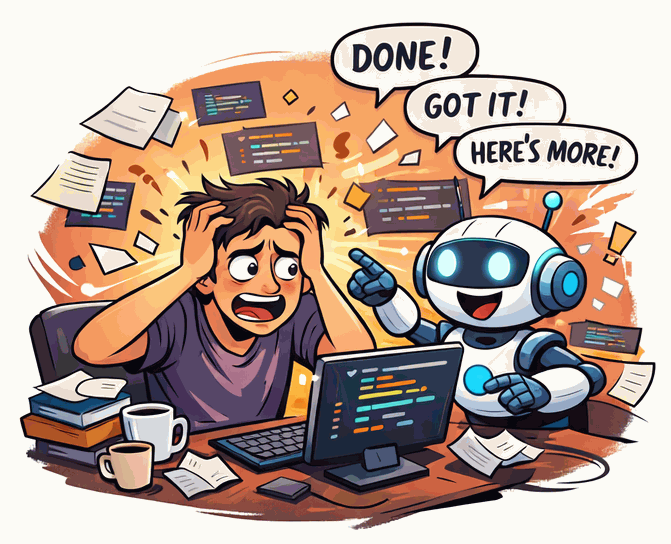
You ask for a feature. Boom—there it is. You ask for a tweak. Done. Another change? Already updated. It’s like pair programming with a robot that drinks triple espresso and never blinks.
It’s also like being stuck in a never-ending debug spiral.
🧠 Your brain needs a breather
When you code solo, there’s a natural rhythm: think, write, run, fix. That rhythm gives you time to realize:
- “Wait, do I actually want this?”
- “Oops, that broke something.”
- “Hmm, maybe this should be simpler.”
With an AI agent, the loop is so fast that idea and implementation blur...