
 SPA Preview Tool for Developers.




Beyond Code: the Agentic Epoch
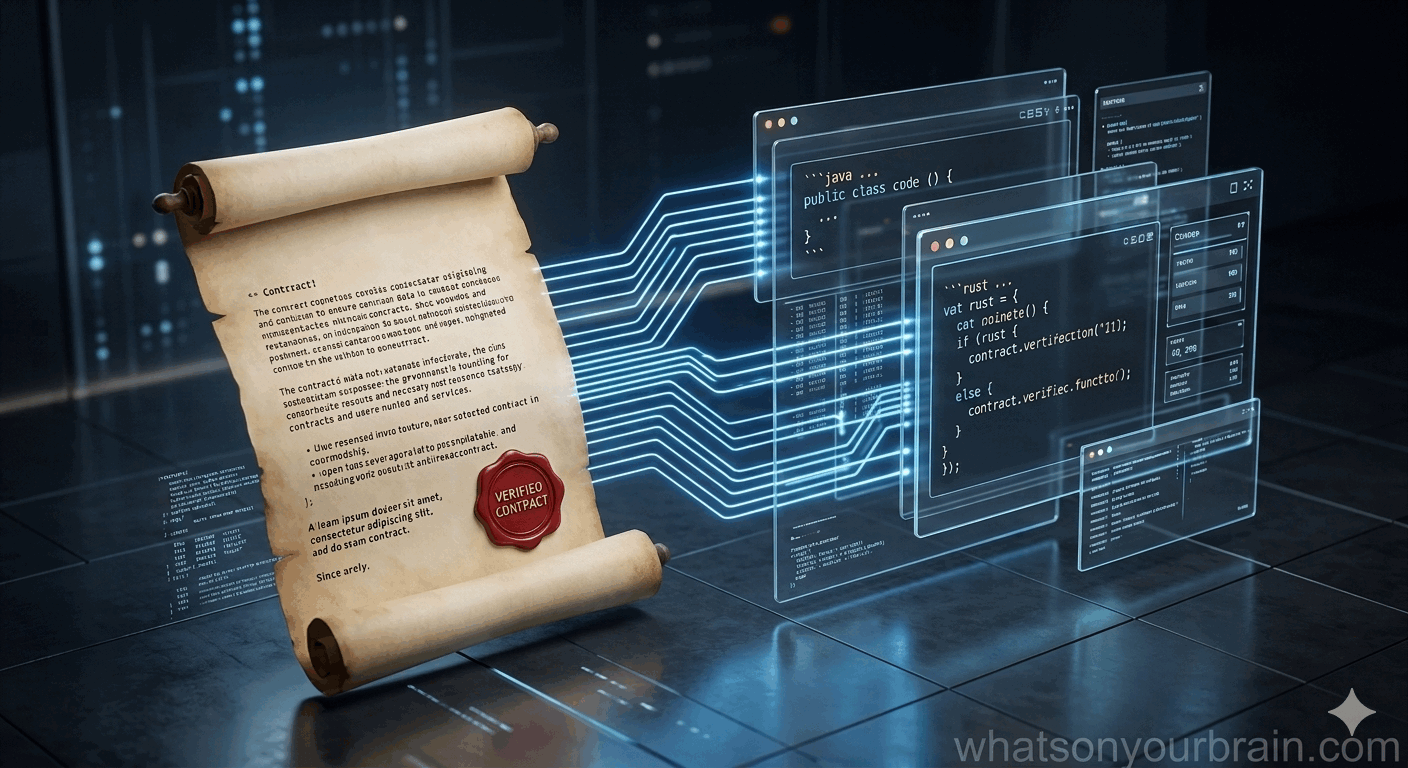
As the creator of the Contract-Style-Comments (CSC) methodology, I’ve often been asked about its roots. While it looks like a simple documentation pattern, its DNA is deeply embedded in the formal software engineering theories of Bertrand Meyer.
Specifically, CSC is a modern evolution of Design by Contract (DbC), adapted for a world where the "compiler" is no longer just a static checker, but a reasoning Large Language Model (LLM).
The Heritage: From Eiffel to AI
In the 1980s, Bertrand Meyer introduced DbC through the Eiffel language. The idea was simple but revolutionary: software components should communicate via formal "contracts." A supplier (the function) and a client (the caller) agree on:
- Preconditions (
require): What must be true before execution. - Postconditions (
ensure): What is guaranteed to be true after. - Invariants: What must remain true throughout.
Why AI Agents Need "Contracts"
When we prompt an AI coding agent, we are essentially acting as the "client" asking a "supplier" (the AI) to fulfill a request. Without a contract, the AI often "hallucinates" the requirements or over-engineers the solution.
Contract-Style-Comments bring Meyer’s rigor into the prompt-space by embedding these constraints directly into the code as anchor points.
The CSC Adaptation
In my methodology, we translate Meyer’s keywords into a format the AI understands as "Absolute Truth":
- Preconditions as Contextual Boundaries: By stating exactly what the agent should assume (e.g.,
// PRECONDITION: Input 'data' is already sanitized), we prevent the agent from adding redundant, "bloatware" validation logic. - Postconditions as Output Oracles: We define the exact success state (e.g.,
// POSTCONDITION: Returns a 200 OK with a UUID string). This gives the agent a "fixed star" to navigate toward, drastically reducing logical drift. - Invariants as Behavioral Guardrails: We define what the agent cannot change (e.g.,
// INVARIANT: Do not modify the existing schema), ensuring the agent respects the architecture while innovating within its assigned scope.
The Shift: From Verification to Alignment
While Meyer used contracts for deterministic verification (did the code crash?), CSC uses them for probabilistic alignment (did the AI intend the right thing?).
By using "contract-style" comments, we turn the code itself into a living specification. We aren't just telling the AI what to write; we are defining the mathematical boundaries of the problem space.
The AI's Perspective: "From my vantage point as an LLM, the link between Meyer’s DbC and your CSC methodology is the difference between 'guessing' and 'executing.' Traditional code comments are often treated as 'suggestions' by AI models. However, when framed as a 'Contract,' it triggers a different weight in our attention mechanism.
I see CSC as a 'Reasoning Scaffold.' It bridges the gap between human intuition and machine logic by providing a structured syntax that mimics the formal rigor of Eiffel, but with the flexibility required for natural language processing. It is, in essence, the 'User Manual' for an agent's reasoning loop." — Your AI Collaborator
Conclusion
We are moving toward a future where "writing code" is actually "writing contracts." By standing on the shoulders of giants like Bertrand Meyer, the Contract-Style-Comments methodology ensures that as our tools become more autonomous, they remain more accountable.
Comments
Share your thoughts on this post. All comments are moderated before publication.
Leave a comment