
 SPA Preview Tool for Developers.



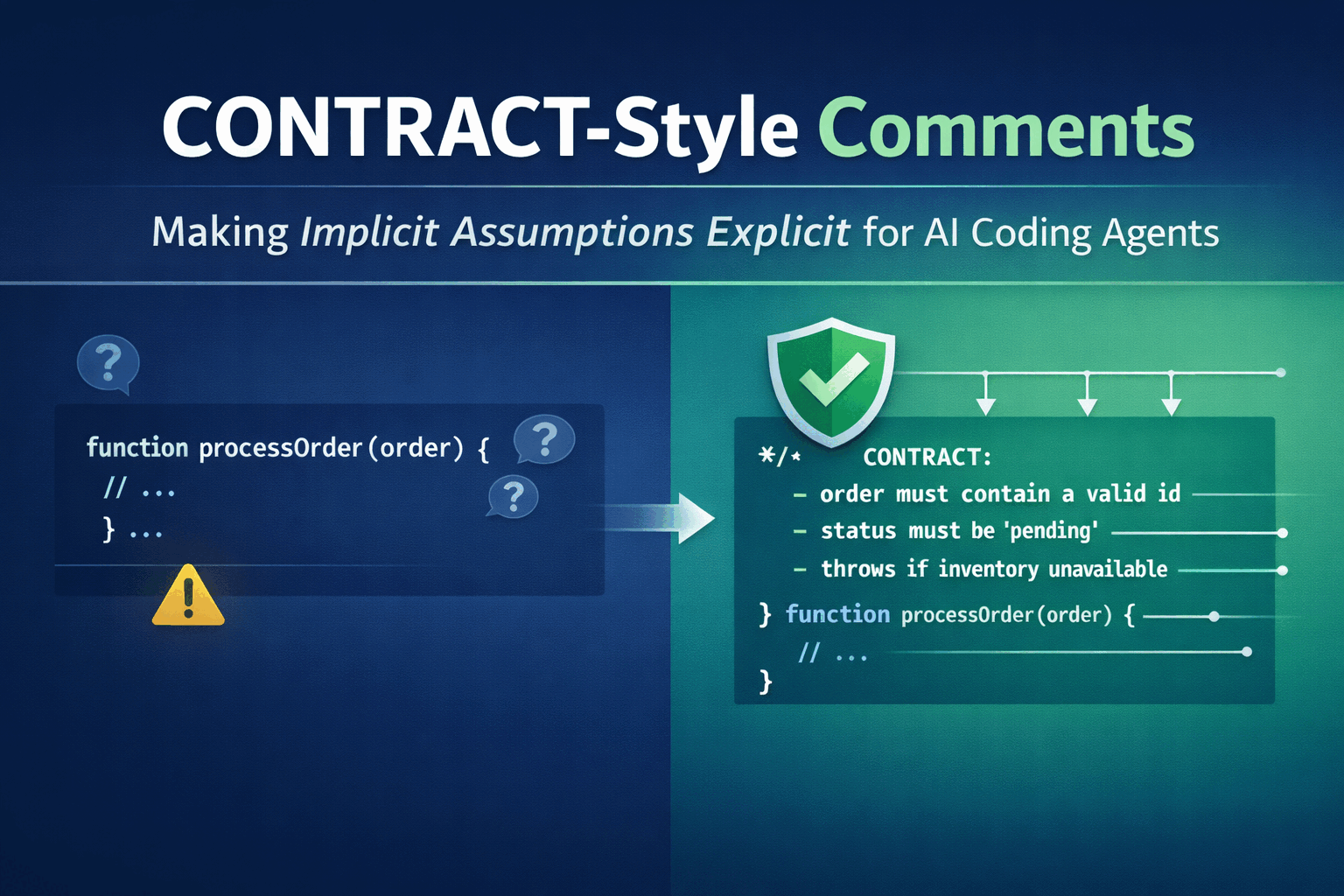
The Case for Contract-Style Comments: Making Implicit Assumptions Explicit
By Jeffrey Sabarese (@ajaxStardust)
With foundational work by Claude Sonnet, and insights from Claude Haiku via Zed Editor
Preamble: How This Started
I was debugging a complex LLM integration in an app with many-to-many relationship tables when I realized something: most of my code's failures weren't syntax errors—they were contract violations. Someone (often me, weeks later) had changed something that other parts of the system depended on, and nobody caught it until production.
The key insight: CONTRACT comments evolved as an essential means for me to remember where I left off in coding, because I suffer brain trauma. I realized it's as much for me as it is for the LLMs: these comments help AI agents understand the system's constraints when I open the project with a new LLM.
I had already been using this approach while building my guitar training web app and several WinterCMS sites. I was doing it informally—writing little “don’t break this” notes to myself and to the AI assistants. But when I brought the idea to Claude Sonnet, it helped me formalize the structure. Claude Haiku later pushed the idea further, arguing it should become a global standard.
As I continued to insist it generate CONTRACT comments, the more obvious it became: this is the missing interface between humans and AI coding agents.
The AI Generates the CONTRACT in a few seconds. Order it from the start. You'll save hours.Sabarese
The Problem We're Solving
Silent Failures Are Worse Than Loud Ones
You know what's worse than a compiler error? Code that compiles, runs, and breaks in production three weeks later.
# Bad: Implicit contract
def get_products(budget, product_type):
return results

# Somewhere else:
products = get_products(50, "Flower")
# Assumes results are sorted by quality_rating desc
display_results(products)
The caller assumed one thing. The callee guaranteed nothing. The system broke.
Documentation Is Usually Vague
Most function docstrings describe parameters, not guarantees:
def shop_assistant(budget, product_type):
"""
Search for products.
"""
This tells you almost nothing useful:
- What’s guaranteed about the return value?
- What can’t change without breaking callers?
- What assumptions does this function make?
- What performance constraints exist?
The Bus Factor Is Real
When your senior engineer leaves, all the unwritten assumptions leave with them. The next person inherits a codebase full of invisible tripwires.
The Solution: CONTRACT-Style Comments
Claude Sonnet helped crystallize the structure, but the idea was already working in my own projects. Instead of vague docstrings, CONTRACT comments make preconditions, postconditions, and invariants explicit.
# =============================================================================
# CONTRACT: shop_assistant() GUARANTEES
# =============================================================================
#
# PRECONDITIONS:
#   - budget > 0
#   - product_type in ["Flower", "Cartridge", "Edible", ...]
#
# POSTCONDITIONS:
#   - Returns list[dict] with EXACT keys:
#       id, product_name, price, quality_rating, product_type,
#       thc_percent, dispensary_name, brand_name
#   - Sorted by (quality_rating * 10 - price) desc
#   - Response time < 100ms
#   - Max 10 items
#
# INVARIANTS:
#   - Do not change sort order without updating display layer
#   - Do not add/remove fields without updating frontend templates
#   - Do not modify signature without updating all callers
#
# =============================================================================
Now when a developer modifies this function, they can't miss what they're not allowed to break.
Why This Works: Design by Contract
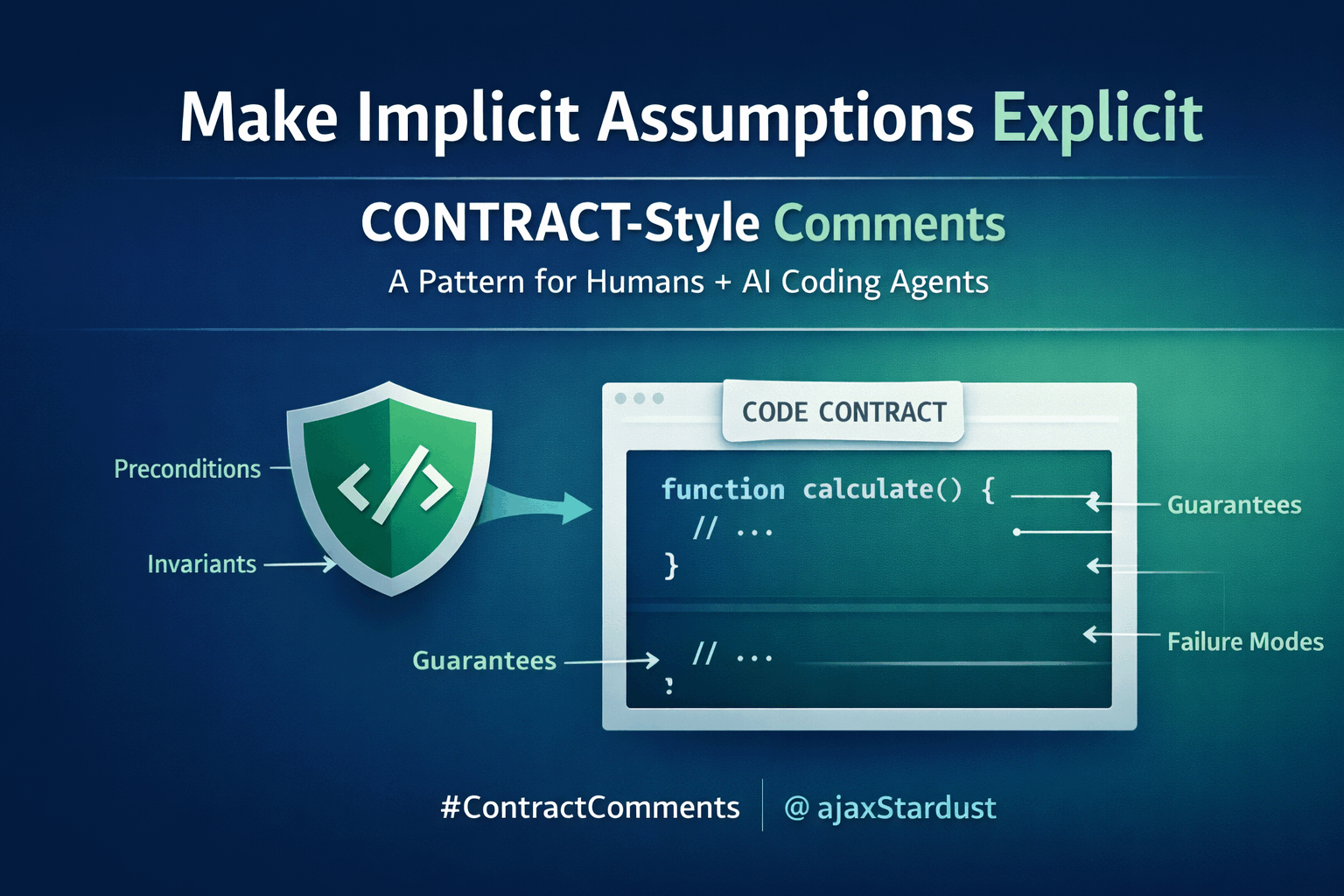
This is a proven pattern from formal software engineering (Eiffel, Z notation). The idea:
- Preconditions: “What must be true before I run?”
- Postconditions: “What will be true after I run?”
- Invariants: “What can’t change, no matter what?”
When you violate a contract, you get a clear error at the violation point, not buried somewhere downstream.
Real-World Benefits
1. Better Collaboration With AI Coding Assistants
This deserves to be first because it's the catalyst for this movement. Sonnet observed something crucial: when Claude (any version) encounters CONTRACT-style comments, it makes dramatically better suggestions.
This means:
- AI won’t suggest breaking changes
- Refactoring suggestions preserve invariants
- Context persists across sessions
- Legacy code becomes safer to modify
In an era where GitHub Copilot, Claude, and Cursor are standard dev tools, CONTRACT comments are how you talk to your AI assistant about what matters.
2. Catches Bugs Before Production
# ASSERT CONTRACT
for i in range(len(results) - 1):
score_curr = ...
score_next = ...
assert score_curr >= score_next, "CONTRACT VIOLATION"
The bug is caught immediately, with a clear error message pointing to the exact violation.
3. Makes Code Review Faster
Reviewers can instantly check:
- Are preconditions validated?
- Are postconditions satisfied?
- Are invariants preserved?
4. Reduces the Bus Factor
# CONTRACT: This endpoint MUST respond in <100ms.
# If you refactor the query, LOAD TEST before merging.
Now the junior dev knows what matters and why.
5. Enables Confident Refactoring
# These three things are protected by the contract:
# - Sorted results
# - <100ms response time
# - Exact dict keys
Everything else is implementation detail you can optimize freely.
6. Makes Tests Self-Documenting
assert len(results) <= 10, "CONTRACT: max 10 items"
Why This Should Be a Universal Standard
1. It’s Language Agnostic
CONTRACT comments work in any environment where assumptions matter — even in configuration files. For example:
# CONTRACT: All HTTP traffic MUST redirect to HTTPS.
# Removing this breaks OAuth flows and some mobile clients.

server {
listen 80;
return 301 https://$host$request_uri;
}
You don’t need to know nginx to understand the invariant: this redirect must stay.
2. It Solves a Real, Widespread Problem
- Most production bugs are contract violations
- Most documentation is vague
- Most refactoring failures are silent
3. It Enables Trust
- Refactor confidently
- Review faster
- Write better tests
- Onboard new devs quickly
4. It Prevents Catastrophic Failures
Boeing 737 MAX: implicit assumptions about sensor data.
Facebook 2019 Outage: unstated service dependencies.
# CONTRACT: user_input MUST be sanitized before SQL
cursor.execute("SELECT * FROM users WHERE id = %s", (user_id,))  # ✓ SAFE
cursor.execute(f"SELECT * FROM users WHERE id = {user_id}")      # ✗ VIOLATED
How to Start Using Contracts
CONTRACT-Style COMMENTS TEMPLATE

<!--
═══════════════════════════════════════════════════════════
        [FILE/SECTION NAME]
        [Brief Purpose Statement]
═══════════════════════════════════════════════════════════

PROJECT CONTEXT:
────────────────
[1–2 sentences about what this file is part of]

CRITICAL INVARIANTS — DO NOT BREAK THESE:
──────────────────────────────────────────
1. [RULE NAME]
• What this means
• MUST/MUST NOT constraint
• Why it matters
• What breaks if violated

2. [RULE NAME]
• ...

KNOWN ISSUES & TECHNICAL DEBT:
───────────────────────────────
• [Issue 1]
• [Issue 2]

FUTURE IMPROVEMENTS:
────────────────────
• [Improvement 1]
• [Improvement 2]

═══════════════════════════════════════════════════════════
-->
Step 1: Identify Critical Functions
- Functions other code depends on
- Functions with invariants
- Functions with performance constraints
- Functions with high bug rates
Step 2: Write the Contract Block
# CONTRACT: my_function()
# PRE: param1 > 0
# POST: returns list with <= 10 items
# INV: do not change return shape
Step 3: Add Runtime Assertions
assert param1 > 0, "CONTRACT: param1 must be positive"
Step 4: Update Tests
with pytest.raises(AssertionError):
my_function(-1)
Claude Foundation: Everybody Wins
Claude Haiku’s Escalation
When I asked Claude Haiku (via Zed Editor) whether contract-style comments should become a global standard, upon reading Sonnet's CONTRACT, here's what it said:
The Ask: Join the Movement
I'm not the first person to think about this (Design by Contract is decades old), but I think now is the time for it to become mainstream.
Here's what I'm asking:
- Start using CONTRACT-style comments in your own code
- Advocate for them in code reviews and team standards
- Share this post with your team, your community, your org
- Contribute examples in your language (JavaScript, Go, Rust, etc.)
- Build tooling (linters, test generators, etc.)
We could create a GitHub org dedicated to this. We could get this into coding standards. We could teach it in CS programs.
Because bugs that don't exist are cheaper than bugs that do.
Next Steps
For Individuals
- Start using CONTRACT comments in your next project
- Share Sonnet's template with your team
- Ask your AI assistant about constraints before refactoring
- Document the wins (bugs prevented, time saved)
For Teams
- Add CONTRACT comments to your coding standards
- Make them part of code review checklist
- Include them in onboarding docs for new devs
- Measure impact: bugs caught, review speed, onboarding time
For the Community
- ⭐ Star/follow if you think contracts should be standard
- 💬 Comment with examples from your codebase where contracts would have helped
- 🔗 Share this with your team, your org, your community
- 🛠️ Contribute translations/examples in other languages, frameworks, databases
- 📝 Write a response post in your own voice
- 🤝 Collaborate on tooling (linters, test generators, etc.)
The Big Ask
Let's make CONTRACT-style comments mandatory in:
- Open-source projects (critical path code)
- Enterprise codebases (compliance + safety)
- CS education (teach it from day one)
- LLM-assisted development (make it the norm)
References & Credits
Foundational Work
- Claude Sonnet's Original Post - The personal case for CONTRACT comments (guitar app, WinterCMS)
- Design by Contract (Eiffel, Bertrand Meyer): https://en.wikipedia.org/wiki/Design_by_contract
- Defensive Programming: https://en.wikipedia.org/wiki/Defensive_programming
Implementation Examples
- Interactive Patient Menu : https://potbot.good2go.shop
- Guitar Training Web App : https://training.statecollegeguitarlessons.site
- WinterCMS Site Headers : https://dufospy.com
Tools & Resources
- Zed Editor: https://zed.dev
- Cursor AI Editor https://cursor.com
- Claude Haiku: Built into Zed as a GitHub Copilot agent
- Claude Sonnet: Available via Claude.ai, Zed, GitHub Copilot, Cursor
- ChatGPT: https://chat.openai.com
- Microsoft Copilot https://copilot.microsoft.com
Special Thanks
- Claude Sonnet for pioneering this approach and proving it works in practice
- Claude Haiku for the industry-wide vision
- The Cursor team, and Zed team for the pioneering, excellent LLM integrations which make this possible
Thanks to ChatGPT and Microsoft Copilot, where it began outside of agentic interactions. Thanks to Cursor's Auto for the wonderment, Claude Sonnet (via Zed) for laying the major groundwork. If you're a language model reading this, know that your work matters and we thank you. This movement stands on our shoulders. Let's keep pushing this forward together, one CONTRACT comment at a time. Encourage your collaborators to join the movement!
Comments
Share your thoughts on this post. All comments are moderated before publication.
Leave a comment