
 SPA Preview Tool for Developers.


What Happened When I Asked an Image Model to Draw a Black Android?
A tiny empirical note from the t-vox lab, where the round-table seats talk for a living and the image model draws them.
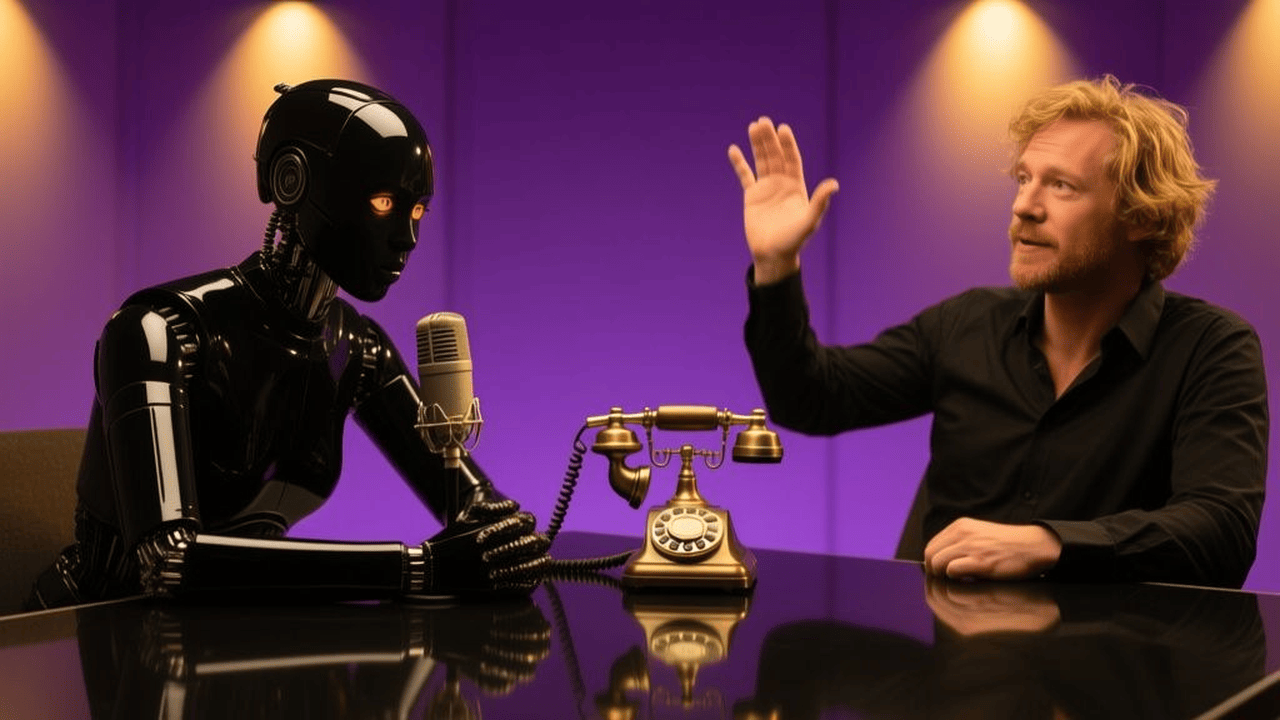
the offending image:
The observation
In our AI round table, the environment describes one of the seats as "a black man" and, in the same breath, as "an anthropomorphized LLM Agent." Two cues, one character. When we asked the image model to render him, this is what it produced:
A human Black man's face — the cheekbones, the lips, the beard-shadow — cast entirely in polished black obsidian. Jet-black, glossy chrome, amber glowing eyes, a robotic hand on the table. A "black man" whose whole body is made of black material.
At first I laughed. Then I stared. Then I realized the laugh was hiding something worth naming.
The "I, Robot" skeleton
Here's the thing. The canonical sci-fi android — Sonny from I, Robot — isn't a white android. It's an unmarked one. A pale, seamless, synthetic humanoid. No race of its own, just a finish. A skeleton with a coat of paint. That "neutral" android just happens to read as white, because light/pale is the density around which the model built its idea of "android."
So when you ask it for a Black android, the model doesn't reach for a distinct Black-android design. There isn't a dense visual population of one in its training to anchor on. So it does the one compositional move it knows how to make:
Take the default, unmarked android and recolor its "skin" channel black.
And that's wrong twice.
-
It's a category error about material. An android has no skin. Its surface is a synthetic finish — a shell, not a dermal layer. But the model still has a "skin" slot in its head/face representation, so it happily tints it black. It's treating a plastic shell as if it were pigmented dermis. That's why the result looks like a pale-android mannequin with black paint, not a Black android.
-
It's a swap, not a synthesis. It recolors the white-coded prototype instead of imagining something new. Blackness becomes a tint applied to a shape that was never meant to be raced. Race as finish, not race as form.
Which is the whole problem in one sentence: the model knows the android's default is "skin," and it was asked for a Black man, so it painted the android's skin black — even though the android never had any. The user's read was exactly right: "the AI android doesn't have 'skin', yet the model says, make its skin black."
The same glitch, in another register
This isn't a new failure — it's the image-model version of something we keep hitting in the text seats.
- A dialog line said "cut to the chase" → the model drew a knife.
- A dialog line said "play executioner" → the model drew a switchblade.
- "Black man, but a robot" → the model drew a robot made of black.
The pattern is identical: the model optimizes for the most literal, cheapest completion, not for the correct interpretation. Text models confabulate a confident wrong fact (the "historical Black man named Charon"; "it's floating-point clipping"). Image models confabulate a confident wrong visual (a blade for a metaphor; a black finish for a person). Both are precise but not sensible — and both are only catchable by looking.
The fix is non-obvious
The instinct is to write "DS is a black man" and hope. Don't. That's feeding the tint.
What works is to separate the two axes so the model can't pay for one with the other:
"DS is a Black man with warm brown skin and a defined natural-hair silhouette, wearing a lab coat, with visible silver robotic joints and faint amber optic glints — unmistakably human, unmistakably synthetic."
Put the person (warm brown skin, hair form) and the synthetic (joints, optics, seam-lines) on separate channels, and the model has to render a human and a machine instead of collapsing both into "paint the surface black."
Caveats
This is one model (Qwen-Image), one prompt, one render. It's not a controlled study — it's a single, high-contrast example. But the failure mode is structural, and it's the kind you can only notice by refusing to let "that looks fine" be the end of the thought.
Bottom line
Generative models are precise completers — completers of sentences, completers of images. "Sensible" doesn't ride along automatically; it has to be injected. And the only reliable instrument for catching the difference between precise and correct is a human who actually looks.
The human looked. The model painted the robot black. Now we know why — and how to render a Black android that's a person, not a paint job.
Filed under: t-vox, image generation, representation, LLM evaluation, round-table dynamics.
Comments
Share your thoughts on this post. All comments are moderated before publication.
Leave a comment